
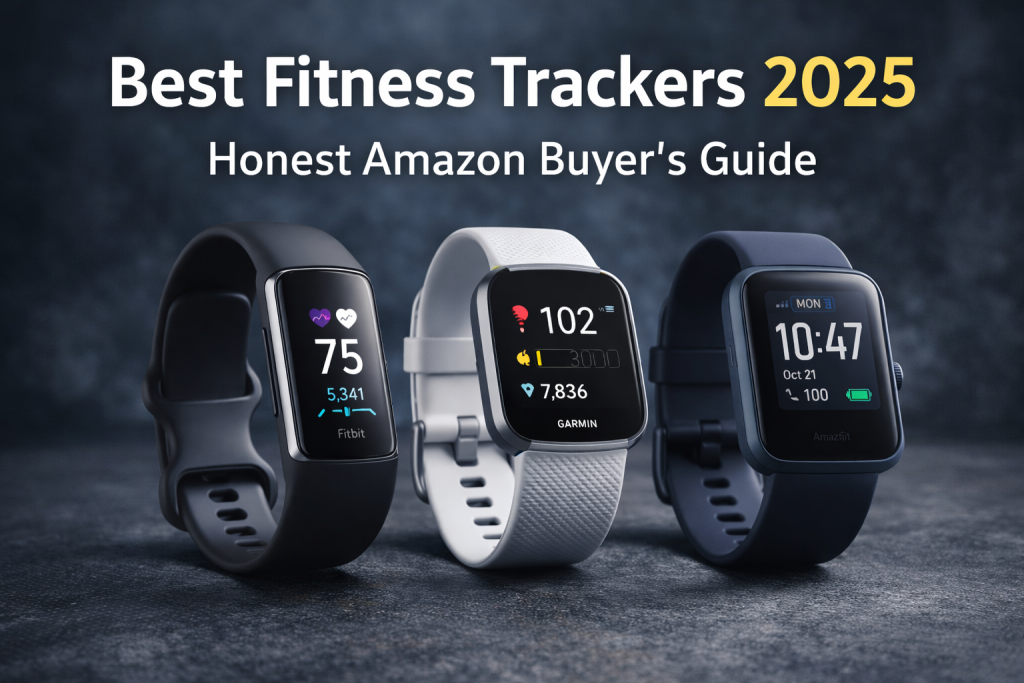
Fitness trackers 2025 have become essential tools for people who want to measure progress, stay motivated, and train smarter. Many people start a fitness journey with good intentions but quickly lose momentum because workouts feel random and progress is hard to track.
1. Introduction
Many people start a fitness journey with good intentions but quickly lose momentum. Workouts feel random, progress is hard to measure, and motivation fades when results are invisible. Others train consistently yet still struggle to understand whether they are improving, overtraining, or recovering properly. Without reliable data, fitness becomes guesswork rather than a structured process.
Choosing the right fitness tracker matters because it shapes how you train, recover, and stay accountable. A well-designed device can turn vague effort into clear feedback, showing your heart rate, sleep quality, activity levels, and long-term trends. A poorly chosen device, however, can frustrate you with inaccurate readings, short battery life, or confusing software.
This guide will help you decide which fitness tracker best fits your goals, budget, and experience level. It compares leading Amazon options, explains how they work, highlights safety considerations, and provides practical advice on selecting and using a tracker effectively.
2. What Is Fitness?
Fitness is the measurable ability of your body to perform physical activity efficiently while maintaining health, endurance, strength, and recovery capacity.
Fitness involves multiple components that work together rather than a single trait.
• Cardiovascular fitness, how well your heart and lungs supply oxygen during activity.
• Muscular strength, the amount of force your muscles can produce.
• Muscular endurance, how long your muscles can sustain effort.
• Flexibility, your range of motion at joints.
• Body composition, the ratio of muscle to fat in your body.
Fitness works through consistent physical activity, proper recovery, nutrition, and progressive adaptation. When you train regularly, your body becomes more efficient at using energy, handling stress, and repairing itself.
Fitness is for anyone who wants to improve health, performance, or overall well-being. Beginners benefit from structure and motivation, while experienced athletes use data to fine-tune training and avoid burnout.
3. Is It Safe to Use a Fitness Tracker?
Most modern fitness trackers are considered low-risk consumer wellness devices. They are designed for general health and activity monitoring rather than medical diagnosis or treatment.
For most healthy adults, daily use is safe. The devices typically sit on the wrist, use optical sensors to estimate heart rate, and collect movement data through accelerometers. These functions do not expose users to harmful radiation or invasive procedures.
However, certain individuals should exercise caution. People with severe skin sensitivities may experience irritation from prolonged contact with the band. Those with implanted medical devices, such as pacemakers, should consult a healthcare professional before use, as some features may interfere, depending on the device model.
Fitness trackers are not regulated by the FDA as medical devices in most cases. They are intended for lifestyle and wellness purposes only. Readings should not replace professional medical advice, diagnosis, or treatment.
Common side effects, though rare, include mild skin irritation, pressure discomfort if worn too tightly, or temporary changes in sleep due to nighttime notifications.
4. Best Fitness Trackers on Amazon (2025)
Fitbit Charge 6
Type: Advanced fitness tracker with GPS
Best For: All-around fitness tracking and health insights
Safety Level: Low risk consumer device
Why it works:
The Fitbit Charge 6 combines accurate heart rate monitoring, built-in GPS, and comprehensive sleep analysis in a slim design. Its algorithms analyze activity patterns to estimate calorie burn, stress levels, and recovery quality.
Key features:
Built-in GPS, heart rate variability tracking, ECG app, SpO2 monitoring, and multi-day battery life.
Pros:
Precise activity tracking
Strong mobile app with clear insights
Built-in GPS eliminates need for a phone
Cons:
Subscription required for full analytics
Limited smart replies compared to full smartwatches
Who should buy it:
Users who want detailed health data in a compact form without upgrading to a full smartwatch.
Garmin Venu Sq 2
Type: Fitness smartwatch
Best For: Training, recovery, and outdoor workouts
Safety Level: Low risk consumer device
Why it works:
Garmin focuses on performance metrics rather than lifestyle features. The Venu Sq 2 tracks workouts, sleep, stress, and body battery levels to help users balance effort and recovery.
Key features:
Built-in GPS, long battery life, workout animations, and body battery energy tracking.
Pros:
Excellent battery performance
Reliable GPS accuracy
No mandatory subscription
Cons:
Interface is less beginner-friendly
App design feels technical
Who should buy it:
Runners, hikers, and fitness enthusiasts who value training data over flashy smartwatch features.
Amazfit Band 7
Type: Budget fitness band
Best For: Beginners and casual users
Safety Level: Low risk consumer device
Why it works:
The Amazfit Band 7 delivers essential tracking features at a low price, making fitness monitoring accessible without major investment.
Key features:
Large AMOLED display, heart rate tracking, sleep monitoring, and long battery life.
Pros:
Very affordable
Lightweight and comfortable
Simple, easy-to-use interface
Cons:
Less accurate than premium models
Limited advanced analytics
Who should buy it:
First-time users who want basic tracking without paying for high-end features.
5. Comparison Table
| Product | Type | Best For | Key Feature | Rating |
|---|---|---|---|---|
| Fitbit Charge 6 | Advanced tracker | All-around health tracking | Built-in GPS + ECG | 4.5 |
| Garmin Venu Sq 2 | Fitness smartwatch | Training and endurance | Body battery tracking | 4.4 |
| Amazfit Band 7 | Budget band | Beginners | Large AMOLED display | 4.2 |
6. How to Choose the Right Fitness Tracker
Budget should be your first consideration. Premium trackers offer advanced analytics, but budget options still provide reliable step counting, heart rate monitoring, and sleep tracking.
Your goals also matter. If weight loss is your priority, choose a device with accurate calorie estimation and activity tracking. If endurance training is your focus, prioritize built-in GPS and performance metrics.
Skin sensitivity is another factor. Soft silicone bands and lightweight designs reduce irritation. If you plan to wear your tracker 24/7, comfort becomes critical.
Experience level plays a role. Beginners benefit from simple interfaces, while advanced users may prefer detailed data dashboards and training insights.
7. How to Use a Fitness Tracker Safely
Wear the device snugly but not too tight, about one finger-width above your wrist bone. This improves sensor accuracy while maintaining comfort.
Charge regularly to avoid data gaps. Many trackers perform best when worn consistently for several days to establish baseline metrics.
Avoid relying solely on calorie burn estimates for major dietary decisions. These figures are approximations rather than exact measurements.
If you experience persistent skin irritation, remove the device, clean the band, and allow your skin to recover before wearing it again.
8. Frequently Asked Questions
Is it safe to use a fitness tracker?
Yes, for most people, fitness trackers are safe for everyday wellness monitoring.
Does it actually work?
Yes, fitness trackers reliably measure movement, heart rate trends, and sleep patterns, though they are not medical devices.
Can it be used daily?
Yes, most trackers are designed for continuous daily wear, including during sleep and exercise.
9. Final Verdict
Best overall choice: Fitbit Charge 6, for its balance of accuracy, features, and usability.
Best budget option: Amazfit Band 7, for affordable yet dependable tracking.
Best for beginners: Amazfit Band 7, due to its simplicity and comfort.
If you want one device that does everything well without feeling overwhelming, the Fitbit Charge 6 is the most practical recommendation for most buyers
Best Home Fitness Equipment for Weight Loss (What’s Worth Buying in 2026)